
Nashville's Unknown Native American Tribe: The Yuchi

Nashville, Tennessee, was once the largest Native American city in the world. Nashville has a dense and rich history with many different tribes, such as the Cherokee, Chickasaw, and Shawnee, which are all a part of Mississippian culture. One tribe that also resided in that area is the Yuchi tribe.
Lesser known, the Yuchi tribe first is recorded in existance in Eastern Tennessee. The language of the Yuchi is called Uchean and it has elements of the Siouan language. Sadly, today their language is rarely spoken, but there is an effort to keep their language alive, but not specifically in Nashville. The tribe’s earliest location was in eastern Tennessee, but they later migrated to present day states such as Georgia, Florida, and South Carolina. Since there is so little information about the Yuchi, it is hard to know exactly why they left Tennessee. However, there is evidence that they may have migrated due to the hostile Shawnee tribe and also “after 1715 in Tennessee, and after the 1790s on the Chattahoochee River, social disruptions caused by colonial pressures forced a shift in the settlement system and resulted in the Yuchis abandoning their towns and villages and living in dispersed homesteads in a pattern similar to early American frontier settler.1 The Yuchi would plant crops along the river and would hunt and fish, which was typical for the region they lived in.
Yuchi Language
Since the Yuchi is lesser known, a simple google search won’t define the Yuchi’s presence in Nashville Tennessee.
“The Tsoyaha (Yuchi) are not well represented in the history books.”2
For me, I never associated Nashville as a place where Native Americans once lived and thrived. I saw Nashville on the surface as a hippy, musical, and artsy city filled with opportunities for rising stars. Now, after my research I still see Nashville in this way, but slightly different. The Yuchi were also artsy people with their art “classified as Eastern geometric style and is expressed in woven textiles as simple diamonds, Vs, and Ws. The diamond motif is thought to represent a rattlesnake. Some experts speculate that certain late prehistoric gorget motifs, especially the Cox Mound style of Tennessee, are expressions of the Yuchi myth of the Winds.”3
Now, I feel like the Nashville arty side comes from the Yuchi, or at least I want to see it that way. I feel like that connection is fitting for the lively city, and I hope that one day Nashville can incorporate art from past tribes such as the Yuchi. While researching, only a few local programs mentioned the Yuchi tribe, one being the Nashville Repertory Theater. At the bottom of their website, in a small font, a land acknowledgment states “We acknowledge that the land on which we meet is the original homeland of the Cherokee Nation, also known as the Ani-Yun-Wiya or “real-people.” We also acknowledge the Chickasaw, Shawnee, & Yuchi tribal nations. We stand upon a painful history of genocide and forced removal from this territory, and honor and respect the many diverse Indigenous peoples still connected to this land on which we gather. The art that we create together is in full ownership of this history.”4 After conducting all of my research, I hope that more places in Nashville can recognize these tribes and not just in a small font at the bottom of a website.
Overall, my research has connected me closer to a city that I thought I already knew everything about. A city on the outside looking in is all about its music and arts, but it’s so much more. It’s a city of dense culture and history, a city where once more than 400,000 Native Americans called their home and where the Yuchi tribe once lived.
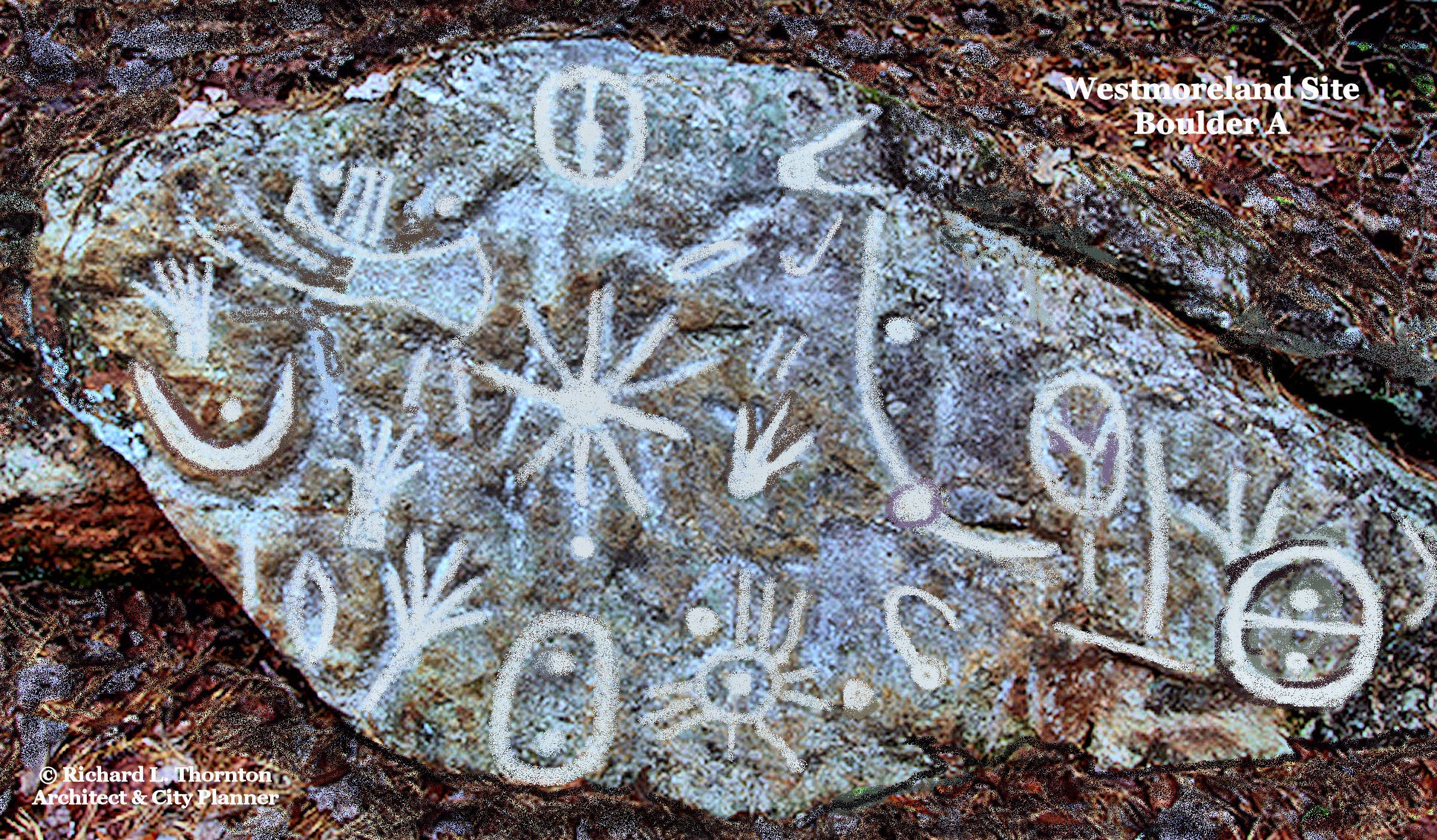
Yuchi Art
Bibliography
Bender, Albert Bender, and Arthur Cushman. “Learn about and preserve Nashville’s rich Native American history | Opinion.” The Tennessean. Accessed May 18, 2022. https://www.tennessean.com/story/opinion/2022/05/18/nashvilles-rich-native-american-history-is-worth-preserving/9748898002/.
Buchner, C. Andrew. “Yuchi Indians.” Tennessee Encyclopedia. Last modified March 1, 2018. https://tennesseeencyclopedia.net/entries/yuchi-indians/.
“Land Acknowledgment.” Nashville Repretory Theater. https://nashvillerep.org/about.
Pritzker, Barry M. “Yuchi.” ABC Clio. Last modified October 2, 2025. https://americanhistory-abc-clio-com.ehslibrary.idm.oclc.org/Search/Display/1223006?terms=Yuchi&sTypeId=2.
Thorton, Richard L. Westmoreland Site Bolder A. Photograph. https://apalacheresearch.com/2019/07/23/the-uchee-yuchi-everything-you-wanted-to-know-but-were-afraid-to-ask/.
“Who Were the Mysterious Yuchi of Tennessee and the Southeast?” Yuchi. http://www.yuchi.org/.
Yuchi Language Project.
C. Andrew Buchner, “Yuchi Indians,” Tennessee Encyclopedia, last modified March 1, 2018, https://tennesseeencyclopedia.net/entries/yuchi-indians/.
“Who Were the Mysterious Yuchi of Tennessee and the Southeast?,” Yuchi, http://www.yuchi.org/.
Buchner, “Yuchi Indians,” Tennessee Encyclopedia.
Land Acknowledgment,” Nashville Repertory Theater, https://nashvillerep.org/about.